Silvan H. Laan
December 2022
silvan.laan@xs4all.nl
The inescapable treatise on architectural origins, Joseph Rykwert's On Adam's House in Paradise (1972), is centered on the Arcadian notion of the primitive hut:
In the present rethinking of why we build and what we build for, the primitive hut will, I suggest, retain its validity as a reminder of the original and therefore essential meaning of all building for people: that is, of architecture. It remains the underlying statement, the irreducible, intentional core, which I have attempted to show transformed through the tensions between various historical forces (Rykwert p. 192).
Starting with Vitruvius, the positing of the primitive hut was always intended to point beyond the Classical canon to a more archaic, formative past. Today, the science of archeology discloses a wealth of information on architectural origins. But Rykwert emphatically rejects an evidence-based treatment of the subject:
Since it is a notion which I wish to stalk, and not a thing, there would be no point in appealing to archeological evidence for its prehistory and origins. There cannot have existed a first house whose authenticity archeologists could certify. They could not even indicate where its site might have been located. To do this, as I have already suggested, they would have to find the Garden of Eden (Rykwert p. 14).
Rykwert erects a straw man here. No one in their right mind is claiming that a single archeological specimen could be singled out as the starting point of architecture. Was it a religious commitment that necessitated Rykwert's reactionary stance?
Other architectural thinkers have turned indeed to archeology and anthropology. In the wake of World War II, members of CIAM (International Congresses of Modern Architecture) stressed the need to connect with origins. Sigfried Giedion was searching for "the original archetypes of art and architecture … the primal, prehistoric forms that he saw simultaneously re-emerging in the art of the contemporary avant-garde" (Strauven p. 238). In the context of CIAM 9 (1953), Aldo van Eyck stated that Western man had to recover "the elements of a primary, general human visual language that have survived through the millennia within the archaic cultures. They are the same forms as those being discovered by contemporary archeology in prehistoric art" (Strauven p. 255).
The appeal to the primitive, as voiced by Giedion and Van Eyck, echoes the central concern of the Romantic era: to revolt against the hegemony of Reason and its technocratic agenda. A pivotal nineteenth century figure is Gottfried Semper:
Semper's Die vier Elemente der Baukunst (Four Elements of Architecture), published in 1851, indirectly challenged the neoclassic primitive hut as posited by the Abbé Laugier in his Essai sur l'architecture of 1753. Based in part on an actual Caribbean hut that he saw in the Great Exhibition of 1851, Semper's primordial dwelling was divided into four basic elements: (1) the earthwork, (2) the hearth, (3) the framework/roof, and (4) the lightweight enclosing membrane (Frampton, 1995, p. 5).
Er ist das erste und wichtigste, das moralische Element der Baukunst. Um ihn gruppiren sich drei andere Elemente, gleichsam die schützenden Negationen, die Abwehrer der dem Feuer des Herdes feindlichen drei Naturelemente; nämlich das Dach, die Umfriedigung und der Erdaufwurf (Semper, p. 55). [The fireplace] is the first and most important, the moral element of architecture. Around it gather three further elements, as it were the protective negations, shields against three elements of nature hostile to the fire of the hearth: the roof [water], the enclosure [wind], and the mound [earth].
Although contemporaneous with Charles Darwin, Semper's origin story was grafted on the antique notion of the four elements, and in that sense can be thought of as pre-evolutionary. The Banister Fletchers, children of the Victorian era, did choose the Darwinian route with passion. Their evolutionary "tree of architecture" reflects the eurocentric bias characteristic of their time.
In recent years, Charles Jencks has mapped the permutations of twentieth century architecture in flowing diagrams, expressive of the postmodern condition. Jencks's diagrams, of course, omit the greater context of ancient history and the vernacular. In their emphasis on the bewildering proliferation of twentieth century output, "the continual revolution", to my mind they unfortunately promote a kind of myopia (Jencks p. 350f).
In this document, I presume to put forward a theory of architecture that reconciles the anthropological interest of Semper and Van Eyck with the evolutionary fervour of Banister Fletcher and Jencks. In a sense, it is yet another chapter in the discourse on the primitive hut.
Everyday experience tells us that the rectangle is the default shape for the architectural plan. Efficiency demands it, how could it be otherwise? There was a time, however, when the rectangular plan was not yet conceived or, arguably, conceivable. For the longest stretch of prehistoric time, when small groups of people lived as hunters and gatherers, the round plan was the universal standard for nomadic dwellings. Archeologist Jacques Cauvin relates as follows:
One can see that in the Natufian house people used stones or wood merely to consolidate a pre-existing wall formed from the Earth itself where the house was dug into it, and then finally roofed the construction. The emergence of the house into the open air and its transition to a rectangular plan thus realise a technical and at the same time a mental linking [sic]. We must not forget that when rectangular architecture appeared at the end of the Mureybetian period, it had never before in any way existed in the world, but then it very rapidly became the archetype of the human house. In that way sedentary people left the hole of their origins and the circular matrix of their first homes (Cauvin p. 132).
To better understand the controversies of cultural evolution we must enter the domain of archeology and anthropology. In those closely related fields, the popularity of evolutionary thinking has waxed and waned since the nineteenth century. Colin Renfrew gives the following synopsis of "evolutionism" in archeological thought:
Lewis Henry Morgan's Ancient Society, published in 1877, offered a broad synthesis. He argued that human societies develop through stages from savagery and barbarism to civilisation, each following a similar pattern. His arguments had an impact upon the thinking of Karl Marx who developed coherent ideas on human development … The Marxist analysis in terms of modes of production could form a coherent basis for analysing technological and social developments within society, rather than depending on diffusionist and migrationist explanations, just as they were to inspire Gordon Childe in his formulation of the neolithic and urban revolutions (Renfrew p. 28ff).
The currently dominant sentiment in the humanities does not favour thinking in terms of universals; the grand schemes of evolutionism continue to bear the stain of eurocentrism. In his plea for a new balance, comparative archeologist Bruce Trigger warns against dogmatism in the debate between rationalism and relativism: "The challenge is to stop simply supporting one or the other of these alternative positions in a partisan manner" (Trigger p. 11). I find Trigger's directness admirable: "I reject the suggestion that the idea of evolution as an approach to the study of human history is inherently and inescapably colonialist and racist" (Trigger p. 41).
The general observation, enabled by archeology, that some forms emerge early, others late in the developmental sequences of societies points to an overarching story of mankind. All societies find their ultimate origin in the hunter-gatherer life and the taming of fire; the peasant village preceded the city-state without exception.
When it comes to explaining the workings of cultural evolution, it is my conviction that mechanistic, neo-Darwinist models will ultimately not suffice. Perhaps in the spirit of Hegel, it is my intuition that the evolution of architectural form reflects an autonomous inward process, a ripening of the human mind that is marked by periods of relative stasis and sudden jumps, largely independent of environmental factors. The twentieth century philosopher and poet Jean Gebser developed a model of historically successive "structures" or states of consciousness that, paradoxically, can also occur simultaneously insofar as the "integral structure" comes to fruition in the individual. The mental structure, which dominates the outlook of modernity, tends to suppress more primal modes of awareness. The integral structure amounts to a breakthrough in which the qualities of all structures become simultaneously accessible to awareness. Gebser regards modern architecture as an important domain for the emergence of the integral structure:
The new conception of space based on the new valuation of time has led to what is today called a "free plan". Le Corbusier took the initiative and was the first to apply the diagonal, and in particular the free and non-geometric curve in his buildings … Rigid and spatially fixed ground plans give way to those which are open, free, and moving … In purely physical terms, the new architecture no longer builds rigid, circumscribed spaces but spatio-temporal continua (Gebser p. 466f).
Writing just years after the end of World War II, Gebser was not naive to the catastrophic potential of a zealous belief in technological progress. He includes the following disclaimer:
The apparent succession of our mutations is less a biological evolution than an "unfolding", a notion which admits the participation of a spiritual reality in mutation. … progress is also a progression away, a distancing and withdrawal from something, namely, from origin. … Once more, it should be emphasized that we must remain suspicious of progress and its resultant misuse of technology (to the degree that we are dependent on it and not the reverse) (Gebser p. 41).
I propose adapting Gebser's system to define five architectural types, each corresponding to an archeological era as well as one of Gebser's structures of consciousness. This system lends prominence to plan and type, arguably at the expense of social, spatial and tectonic considerations. Its merit is its ability to liberate designers from the tyranny of novelty, because it provides an integral alternative to the myth of progress.
| archeological era | Gebserian structure | type | plan form |
|---|---|---|---|
| lower/middle paleolithic | archaic | archaic | point/line |
| upper paleolithic | magic | pastoral | circle |
| neolithic | mythical | agrarian | rectangle |
| metal ages | mental | monumental | symmetric/axial |
| contemporary | integral | integral | asymmetric/pluralistic |
Architects nowadays are pathologically addicted to change … This, I suggest, is why they tend to sever the past from the future, with the result that the present is rendered emotionally inaccessible, without temporal dimension. I dislike a sentimental antiquarian attitude toward the past as much as I dislike a sentimental technocratic one towards the future. … So let's start with the past for a change and discover the unchanging condition of man (Aldo van Eyck, quoted in Frampton, 2007, p. 298).
Gebser left us a balanced postmodernism that does not throw away the baby of reason with the relativist bathwater. He proposes curtailing the dominance of rationality in favour of an integral sensibility, cultivating the free flow of energy and information between subconscious depth and mental surface. Many avant-garde artists and architects have successfully risen to the challenge. Still, contemporary architecture often seems stuck in a restless pursuit of novelty. According to Heinrich Engel, what is needed is the ability "to incorporate an existing architectural form through post-interpretation into an existing framework of religion-philosophy and thereby essentially change its aesthetic meaning without necessarily altering its external shape" (Engel p. 482). The notion of post-interpretation is a useful one. Our priority lies not with the invention of new forms but rather with a process of re-valuation and recombination of what already exists.
Integral design, founded on a Gebserian understanding of architecture in evolution, will typically be indistinguishable, outwardly, from (post)modern design. However, armed with a new awareness of evolutionary context, designers know that they are "merely" creating arrangements of elements sampled from four foundational types: archaic, pastoral, agrarian and monumental (with the arrangement itself constituting the integral metatype) in a process of non-linear recapitulation (after Haeckel: "ontogeny recapitulates phylogeny"). The designer is also at liberty to produce works that are singular expressions of each of the primal types, or, and this is essential, to let vernacular manifestations of those types flourish without interfering. Such manifestations possess a timeless integrity, immune to the need for progressive improvement. In the evolution of biological life, bacteria preceded invertebrate animals, which in turn preceded vertebrates. But the newly emerging forms of higher complexity never replace those of lower complexity, they are rather like embellishments placed on primeval foundations. Each level performs a unique and enduring role in the great chain of being.
Originally, archetypal forms arose spontaneously, whenever their time had come. Now, this innocence is lost. We act in the knowledge that our use of elementary shapes reflects the deep structure of the mind.
Leaving behind the functional demands of the Great Depression and the allure of Nazism, Philip Johnson in the late nineteen forties worked to reconcile modern architecture with a sense of monumentality. For Johnson, this meant a rehabilitation of the ornate (Frampton, 2007, p. 240). The Glass House (designed 1945-48, New Canaan, Connecticut) became the embodiment of an eclectic, liberal approach that prefigured postmodernism.
The Glass House stylistically is a mixture of Mies van der Rohe, Malevich, the Parthenon, the English garden, the whole Romantic Movement, the asymmetry of the 19th century. In other words, all these things are mixed up in it but basically it is the last of the modern, in the sense of the historic way we treat modern architecture today, the simple cube (Johnson).
The splitting off from the Glass House proper of the Brick House, which came to accommodate the more mundane aspects of domestic life, tempts one to psychoanalyse the architect. Is this a case of the repression of earthly beginnings? In any case, the rectangular plan of the Glass House, as well as the brickwork elements, ultimately refer to the neolithic age and thus, the agrarian type. We may choose to distance ourselves from it, but the formative influence of agricultural society is so deeply nested in us, it is impossible to evade.
I finally, in despair of getting the house on the knoll because the knoll is too small, I had to take half the house and put it back against the hill, which is the way it is now. So I put a pavilion out on the end so I could look around the world the way you can from a bandstand in a Middle Western town. You stand on the bandstand in off-season and there's the town at your feet (Johnson).
Having established the presence of the monumental ("the Parthenon") as well as the agrarian type, recognizing the pastoral type in the roundness of the brick fireplace/bathroom is straightforward. The archaic element of the fireplace is fused with the pastoral in a natural way. Here, Johnson acknowledges the primitive in a deliberate manner, even invoking the instinctive behaviour of a dog, like a latter-day Cynic:
The closet into the bedroom makes one plane, the kitchen makes another, both of them anchored by the circular bathroom. That gives you an anchor from which the others radiate. … you can sit down on the central area, which is a rug, which is also in front of the fire, which is the aim of any house. When you enter a house, you, metaphorically you sniff like a dog, and sniffing the way a dog finds his place to sit down is to go round and round until he finds the epicenter of comfort and then curls up (Johnson).
I regard the Glass House as a landmark example of the integral metatype. The symmetry of the elevation refers to the Greek temple, epitome of the monumental. But the incorporation of the umbilical brick hearth in the asymmetric floor plan constitutes a whole that addresses mind as well as organism.
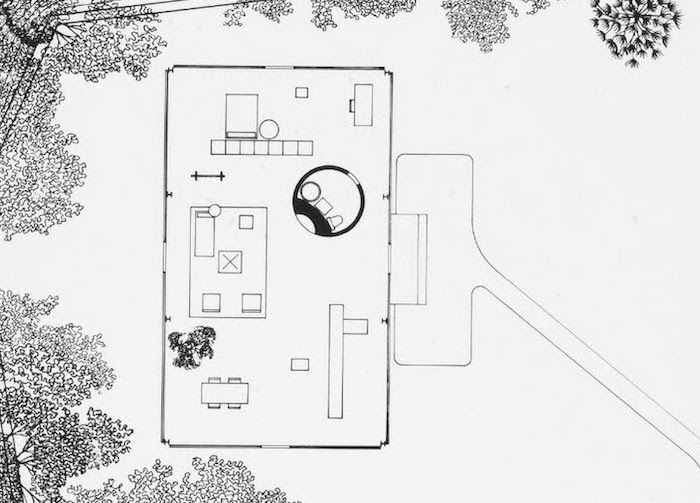
Glass House, plan (The Glass House).

Maison de Week-end, plan (Fondation Le Corbusier).
In Le Corbusier's Maison de Week-end (1934, La Celle-Saint-Cloud, France) the fireplace, like in the Glass House, takes up central position and is rendered in fair-faced brick. In contrast to the cylinder shape employed in the Glass House, however, the hearth in Maison de Week-end is given a rectangular volume, parallel to the rectilinear volume of the house, leaving the center-less extension of the asymmetrical plan uninterrupted.
Le Corbusier's house embraces a mature evergreen tree on its west side. The tree is integrated in an earthen slope which itself forms the connection between the landscape and the green roof. I regard the tree as a point-like, anchoring element representing the archaic type, perhaps compensating for the denial of a center inside. The archaic type is also evident in the amoeba-shaped garden path.
During the first two decades of his career, Le Corbusier was still engaged in an oscillation between mind and body, simply put. Take for instance his changing attitudes to straight versus curved roads. In 1910, the young architect praises the erratic movements of a pack-donkey traversing a hill (Jencks p. 63). Just one year later, he reverts back to a puritanical, classical position: "I am possessed of the color white, the cube, the sphere, the cylinder, and the pyramid ... straight roads, no ornament" (Jencks p.88). In his mature style, Le Corbusier was finally able to bring the opposing categories to a synthesis. In the words of Charles Jencks:
His architecture starts to shift from the white machine aesthetic toward a hybrid, rough mode that combines crude hand-built masonry and factory-built systems … Instead of white machines for living … he produces mud huts with grass roofs … curved cities based on the meander of rivers and the thighs of women … LC becomes a Post-Modernist before the fact, a nascent eco-hippy, building regional and contextual objects that are poems to nature-worship (Jencks p. 188f).
"Post-modernist", "eco-hippy", there are many possible ways to typify Le Corbusier's hybrid style. Taking Gebser's philosophy as the point of departure, I would argue that Le Corbusier embodied the integral spirit that emerged from the growing suspicion of technological progress. Le Corbusier conducted his experiments almost a full century ago. But their relevance in the continual struggle with alienation is undiminished.
The campfire has been in the center of social life since the beginning of the time of man. Primordial man (Homo erectus) was already warming his body by the fire a good million years ago. Fire not only gave warmth and light, dried wet clothing, and cooked meat, but was also sacred and healing. It was the sun spirit or the heavenly fire that had taken up residence among the people. The ring of boulders that were placed around the fire were the original medicine wheel. The stone circle became the focus (in Latin, focus means fireplace) of the sacred. Later, in the Neolithic period, stone circles such as Stonehenge took on gigantic proportions (Müller-Ebeling et al).
The first people to colonize Eurasia were possibly groups of Homo ergaster some 1.5 million years ago. It is likely that the control of fire was what enabled them to colonize cooler regions, although unequivocal proof for hearths occurs not earlier than about 150,000 years ago, in the Middle Paleolithic, at cave sites belonging to Homo neandertalensis such as Le Lazaret in southern France (Scarre p. 115f). The fireplace was the magnetic point around which social life was organized. To be able to contain this force of nature, radiating warmth and light, surely impacted the psychology of ancient people in a major way. It was a game-changer in terms of self-confidence and power in the face of an often inhospitable and hostile environment. Communion with the radiant plasma of fire may have catalyzed the genesis of consciousness itself.
The men of ancient times bred like wild beasts in woods and caves and groves, and eked out their lives with wild food. At a certain moment it so happened that thick, crowded trees, buffeted by storm and wind, rubbed their branches together so that they caught fire: such men as witnessed this were terrified and fled. After the flames had calmed down, they came nearer, and having realized the comfort their bodies drew from the warmth of the fire, they added wood to it, and so keeping it alive they summoned others and pointed it out with signs showing how useful it might be (Vitruvius, De Architectura Libri Decem, Rykwert p. 105).
The only shelters [the Aranda] put up for their own use are windbreaks of bush and scrub which are made by weeding and trimming as much as by piling up. They sleep out in the open, sheltered by these breaks, with small fires to warm them up in cold seasons. These breaks also play an important part in the "construction" of their ceremonial grounds (Rykwert p. 185).
Thus, in the habitation of the primitive peoples of the North American and North Asian Arctics we find a central post that is assimilated to the axis mundi, i.e., to the cosmic pillar or the world tree, which, as we saw, connect earth with heaven. In other words, cosmic symbolism is found in the very structure of the habitation (Eliade p. 53).
[On cosmogony, cf. the discussion of the Berber house (Bourdieu) in Frampton (1995, p. 14), also the domus-agrios dichotomy in Hodder, and structuralism, Claude Lévi-Strauss]
The rise of Homo sapiens in the Upper Paleolithic is associated with a proliferation of cultural output. Tools made of stone, bone, ivory and wood become extremely detailed in form, and varied in function. We are all familiar with the "Venus" figurines from this period, and hunting scenes painted on cave walls. Domestication of animals, primarily the dog, is likely to have taken place in the Upper Paleolithic (Scarre p. 183). People lived in small groups as food gatherers, hunters and herders. They (or "we") constructed mobile huts or tents with a circular plan, forerunners of contemporary nomadic dwellings.
Had people for over a million years lived as nomadic hunter-gatherers, the Neolithic or New Stone Age brought the nearly simultaneous adoption of several important cultural changes: a sedentary lifestyle, the domestication of plants and animals, and new styles of visual expression. The neolithic way of life arose seemingly independently in areas across the globe, and then spread extensively, roughly between 12,000 and 3000 BC (Scarre p. 191). The events of the Neolithic define to a large extent our contemporary cultural habits, not only in terms of architectural form, but also in terms of the binary opposition of man and nature that is implied in the act of domestication.
The Neolithic seems to have had its seminal moment in the eastern Mediterranean with the Natufian culture. Here, stone sickle blades and grinding stones indicate the harvesting of wild cereal. Relatively large villages of around 300 inhabitants appear for the first time. Natufian houses were some 4 meters in diameter, circular or oval in shape. They had a permanent nature, sunken into the ground. The paved floor had a hearth in the center; interior wooden posts presumably supported a thatched roof (Scarre p. 210). In terms of its roof construction, the Natufian house, like similar structures from neolithic Japan (Kazunori p. 129ff), foreshadows the archetypal farmhouse still in use today around the world. The roof-supporting posts of the Natufian houses have their counterpart in the bent, the timber frame of contemporary barns.
From a European perspective, a line of ancestry can be traced back from the column-and-beam grid of modern architecture and the contemporary barn, through similar forms in Medieval times, Iron and Bronze Ages, to the longhouse of the Linear Pottery Culture. Originating from the Danube river plains, the Linear Pottery Culture spread northward along the forested rivers of Europe in the fifth millennium BC. Riverside settlements consisted of elongated houses up to 60 meters long, boasting a dense grid of precisely spaced columns. The Danubian longhouses were uniformly oriented like compass needles, the entrances usually pointing to the south-east (Hodder p. 170). Some Danubian settlements are protected by circular enclosures consisting of a ditch, palisade and earthen wall. Such enclosures, echoes of the pastoral type, do not always contain houses. They may have functioned as cattle corrals or possessed " … conceptual and social functions to do with wider group definition" (Hodder p. 125). I see an artistic mind at work in the architecture of the Linear Pottery Culture, which was contemporary with the Ubaid culture of Mesopotamia. Also there, builders were manifesting an intricate, symmetric architecture.
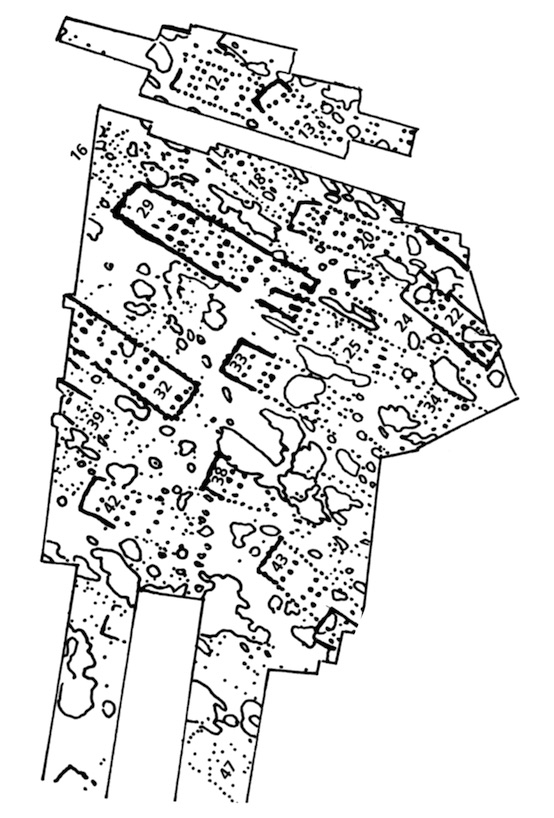
Linear Pottery Culture settlement (Coudart).
The quest for the origins of rectangular architecture points in a south-easterly direction, like indeed the Danubian longhouse itself does. Archeologists situate the emergence of rectilinear architecture around 9000 BC, along the Euphrates river in northern Syria, where important sites have been destroyed as a result of dam construction in the nineteen nineties (Stordeur p. 1). The site of Jerf el Ahmar provides a remarkable example of the "invention" of the rectangular floor plan, a metamorphosis that took several centuries to complete. The site consists of some sixty architectural units distributed over several levels. Danielle Stordeur gives the following description:
The first four [levels] have only produced round constructions (VII/E to IV/E). The three following have constructions with rectilinear interior walls and fairly straight exterior walls, articulated by large curving angles (III/E to I/E). In level O/E the first strictly rectangular constructions appear (Stordeur p. 1).

Village I/East, Jerf el Ahmar (Stordeur).
Archeologist Jacques Cauvin relates as follows:
One can see that in the Natufian house people used stones or wood merely to consolidate a pre-existing wall formed from the Earth itself where the house was dug into it, and then finally roofed the construction. The emergence of the house into the open air and its transition to a rectangular plan thus realise a technical and at the same time a mental linking [sic]. We must not forget that when rectangular architecture appeared at the end of the Mureybetian period, it had never before in any way existed in the world, but then it very rapidly became the archetype of the human house. In that way sedentary people left the hole of their origins and the circular matrix of their first homes (Cauvin p. 132).
Following the neolithic revolution, the rectangle becomes the standard form for utilitarian buildings. Roundness is reserved for sacred, communal or ceremonial structures rather than dwellings, as in the Linear Pottery enclosures, or such canonical works as Stonehenge or the Roman Pantheon.
The social roles and practices of citizens were routinized within the urban layout of monumental constructions, streets and pathways, walls and courtyards. The built environment itself demonstrated the superior access to knowledge and planning held by rulers, ostensibly on behalf of all (Yoffee p. 91).
The monumental type first became manifest in Mesopotamia in the fifth millennium BC, when temple complexes were built with a strong sense of symmetry. Grand pyramidal structures appeared like representations of the hierarchically stratified urban societies that produced them. To employ a truism, the seminal events of Mesopotamia as well as Egypt kicked off the history of civilisation and the (neo)classical styles of architecture in their great variation, sophistication and, sometimes, banality.
The use of copper started in Mesopotamia around 6000 BC (the Chalcolithic age), followed by the Early Bronze Age around 3000 BC; the emergence of the cuneiform script out of pictorial writing is attributed to the latter period. The smelting of gold, copper and silver, and the invention of writing may have evolved independently in Egypt, although commerce with Mesopotamia apparently did exist (Rykwert p. 170).
The design of the stepped pyramid at Saqqara, 60 meters in height, is attributed to Imhotep, as a tomb for king Djoser around 2500 BC. This structure was succeeded by the great pyramid at Giza, c. 150 meters in height, with its complex section of sloping passages and chambers, designed and built with uncanny precision (Scarre p. 374). Architecture in the strict sense, a deliberate, geometric discipline, has entered the scene.
The advent of vertical architecture, metallurgy and literacy is accompanied by the emergence of the city. Roger Matthews writes: "Although we find large agglomerations of people much earlier, for example at Çatalhöyük in the neolithic period of Anatolia, it is only in Late Chalcolithic Mesopotamia that we can detect a real multiplicity of function within those settlements, which enables us to identify them as true cities" (Scarre p. 439).
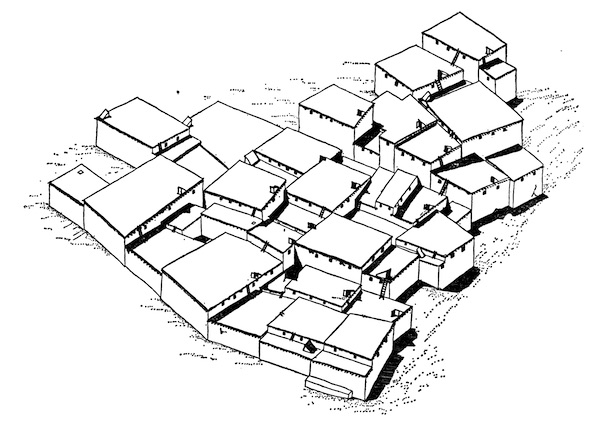
Çatalhöyük (Mellaart).
The verticality of neolithic tell (hill) sites such as Çatalhöyük was a result of the accumulation of successive generations of mud brick construction. Perhaps the tell phenomenon can be said to foreshadow the intentional emphasis on verticality that begins to appear in the Ubaid period (5000 — 4000 BC) in Mesopotamia. Gwendolyn Leick describes a fifth millennium precursor of the ziggurat at the site of Eridu, now southern Iraq: "… all the earlier ruins were filled in with sand and enclosed with a brick wall, to provide the basis for a new building elevated from the surrounding areas by one meter and accessed by a ramp" (Leick p. 6). In the subsequent Uruk period (4000 — 3000 BC), the ziggurat typology would materialize: a stepped platform in solid sun-dried brick.
Japan in the late Middle Ages saw the rise of an urban merchant class, prompting the need for a commoner's architecture. A new type had to be developed since strict feudal regulations meant the new architecture could be neither modeled on the peasant house nor on the formal residences of the upper classes. Under the influence of Zen buddhism, the humble tea hut became a place of experimentation where a new architecture could take shape. Antithetical to the opulence of aristocratic architecture, the tea masters adopted elements of the peasant vernacular, cultivating a rustic simplicity that became one of the defining characteristics of the new sukiya (tea house) style.
The earlier shoin style, used by the warrior and bureaucrat classes, already showed mixed features of the rural vernacular and buddhist architecture. Distinct from formal temple planning, shoin style floor plans were asymmetrical, even though the building layout was still prescribed by rigid protocol. The innovations of the tea hut allowed the shoin style to evolve toward a new style marked by free plans as well as a taste for material clarity. The new sukiya style was initially adopted by the elite for the building of private palace retreats, a way of escaping the formalism imposed by the feudal system. The new style was also used for public buildings such as restaurants and inns, places where the social classes could mingle. This provided the springboard for the flourishing of a new residential architecture for the middle class in a blind spot of government regulation.
The sukiya style introduced an egalitarian spirit, free planning and a refined austerity in Japanese architecture some four hundred years before modernism made similar achievements in the West.
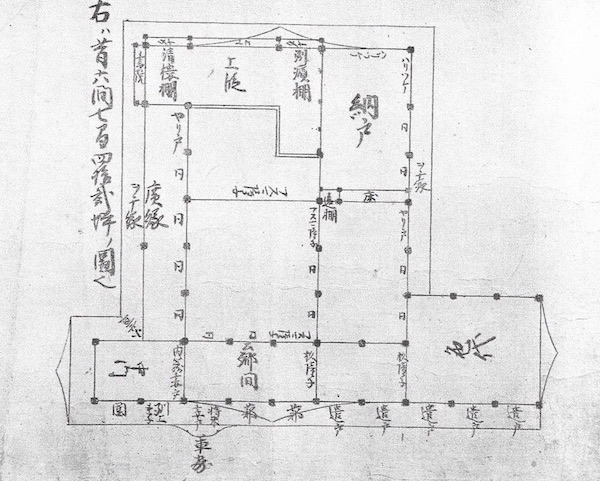
"Plan of the shuden style, the residential style of the warriors in the late Middle Ages of Japan. It is a simplified form of the shoin style and integrates architectural features of the residences of the farmer, the clergy, and the nobility" (Engel).
Since the sukiya style already embodied elements of modernism, Japanese architects, unlike many of their counterparts in the West, could accept the new ideology without any feeling of resistance and without psychological complications. In fact, when we look at certain modern structures in Japan, it is often difficult to tell whether they were constructed according to purely Western concepts or whether they reflect elements of the sukiya style. In any case there is no point in attempting to make such an analysis, and no one in Japan has ever thought of doing so (Itoh & Futagawa p. 107).
For Japanese architects in the aftermath of World War II, the shock of atomic annihilation was paired with the promise of large-scale planning on tabula rasa. Japanese tradition and the legacy of the Western avant-garde were brought to a synthesis by the Metabolist group in the fifties, sixties and seventies. For all its futurism, Metabolist architecture embodies ancient notions of impermanence and regeneration as exemplified by Ise shrine, essentially a prehistoric farm house with a continuous existence of 1200 years, its material constituents being replaced ("metabolized") every 20 years (Koolhaas & Obrist p. 385). In the words of Kenzo Tange: "In the same way as life, as organic beings composed of changeable elements, as the cell, continually renewing its metabolism and still retaining as a whole a stable form — thus we consider our cities" (Koolhaas & Obrist p. 197).
Cauvin, Jacques, The Birth of the Gods and the Origins of Agriculture, Cambridge University Press, 2000.
Coudart, Anick, Architecture et Société Néolithique, Éditions de la Maison des Sciences de l'Homme, 1998.
Curtis, William J. R., Modern Architecture Since 1900, Phaidon, 1996.
Eliade, Mircea, The Sacred and the Profane: The Nature of Religion, Houghton Mifflin Harcourt, 1959.
Engel, Heinrich, The Japanese House: A Tradition for Contemporary Architecture, Charles E. Tuttle Company, 1964, eighth printing 1978.
Frampton, Kenneth, Studies in Tectonic Culture: The Poetics of Construction in Nineteenth and Twentieth Century Architecture, MIT Press, 1995.
Frampton, Kenneth, Modern Architecture: a Critical History, Thames & Hudson, fourth edition 2007.
Gebser, Jean, The Ever-Present Origin, authorized translation by Noel Barstad with Algis Mickunas, Ohio University Press, 1985.
Hodder, Ian, The Domestication of Europe, Basil Blackwell, 1990.
Itoh, Teiji & Yukio Futagawa, The Elegant Japanese House: Traditional Sukiya Architecture, Weatherhill/Tankosha, 1969, third printing 1982.
Jencks, Charles, Le Corbusier and the Continual Revolution in Architecture, The Monacelli Press, 2000.
Johnson, Philip, from an interview conducted on behalf of the National Trust for Historic Preservation, 1991, as found on theglasshouse.org.
Kazunori, Takada et al., Reconstruction of a Jomon Period Sod Roof Pit House, Nihon Kôkogaku no.15, May 2003.
Koolhaas, Rem & Hans Ulrich Obrist, Project Japan, Taschen, 2011.
Leick, Gwendolyn, Mesopotamia, Penguin, 2002.
Levin, M. G. & L. P. Potapov, The Peoples of Siberia, University of Chicago Press, 1964.
Mellaart, James, Çatal Hüyük: a Neolithic Town in Anatolia, McGraw-Hill, 1967.
Müller-Ebeling, Claudia et al., Witchcraft Medicine: Healing Arts, Shamanic Practices and Forbidden Plants, Simon and Schuster, 2003.
Renfrew, Colin, Prehistory, Phoenix, 2007.
Rykwert, Joseph, On Adam's House in Paradise: The Idea of the Primitive Hut in Architectural History, second edition, MIT Press, 1984.
Scarre, Chris (ed.), The Human Past, Thames & Hudson, 2005.
Semper, Gottfried, Die vier Elemente der Baukunst: ein Beitrag zur vergleichenden Baukunde, Friedrich Vieweg und Sohn, 1851.
Stordeur, Danielle, New Discoveries in Architecture and Symbolism at Jerf el Ahmar (Syria), 1997-1999, Neo-Lithics 1, 2000.
Strauven, Francis, Aldo van Eyck, Architectura & Natura Press, 1998.
Trigger, Bruce, Understanding Early Civilizations: A Comparative Study, Cambridge University Press, 2003.
Yoffee, Norman, Myths of the Archaic State: Evolution of the Earliest Cities, States and Civilizations, Cambridge University Press, 2004.